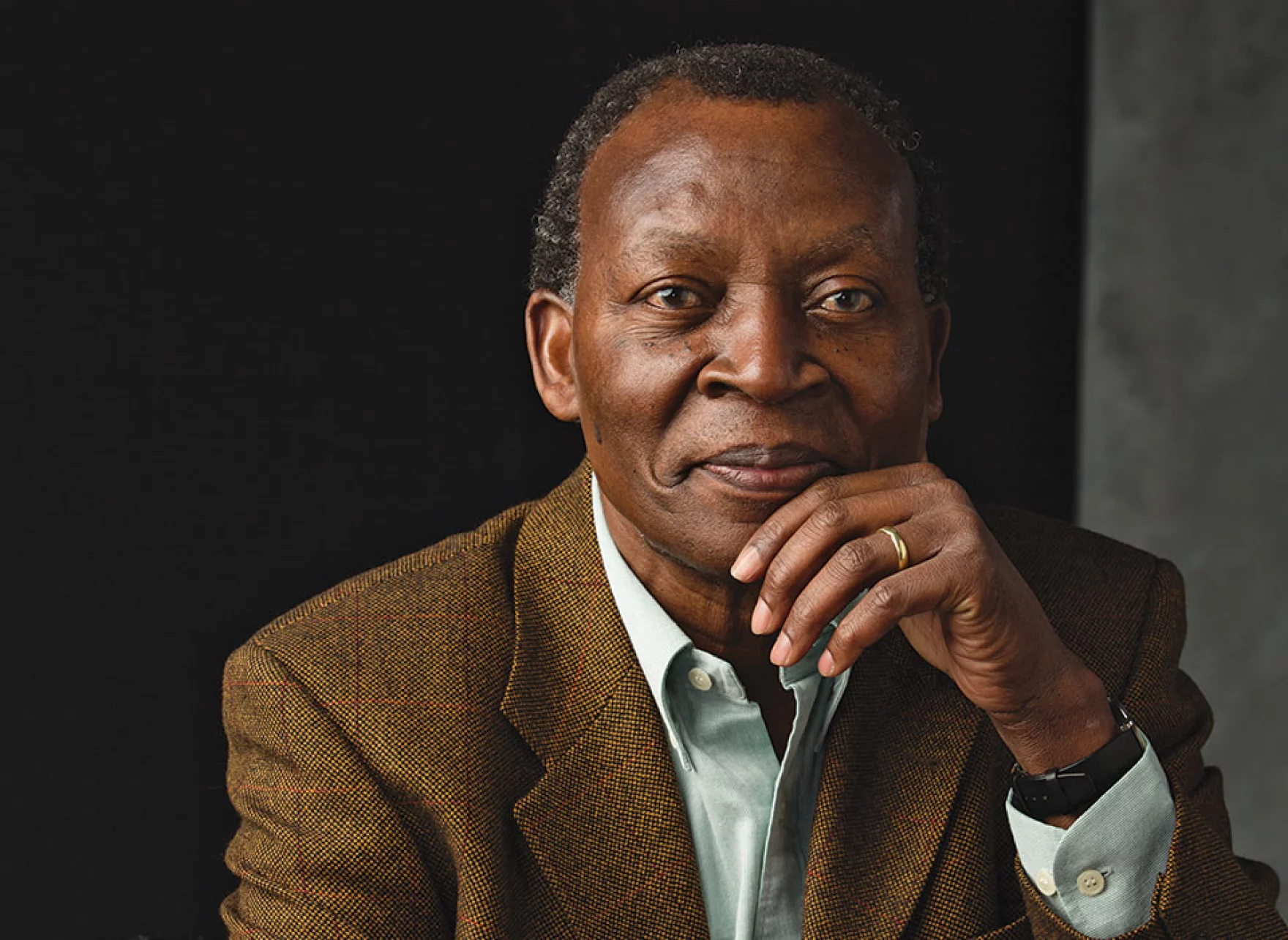
In this edition of Author Spotlight, we will examine the life and works of renowned Ghanaian poet and diplomat Kofi Awoonor. To read Kofi Awoonor is to sit by a hearth fire in a traditional Ewe village, listening to the high priest weave a song of mourning and rebirth. While many of his contemporaries leaned heavily into Western literary styles to express their anti-colonial stance, Awoonor went in the opposite direction. He went back to the roots. He took the rhythmic, heavy-hearted cadences of the Ewe oral dirge, and translated it into modern English verse. He was a literary bridge builder, a statesman, and a profound thinker who believed that a nation without its old stories is a nation without a soul.
Birth and Early Years
Born George Awoonor-Williams on March 13, 1935, in Wheta, a small town in the Volta Region of Ghana, Kofi’s early years were enveloped by the culture of the Ewe people. His grandmother was a traditional dirge singer, and from her, he learned the weight of words, the power of repetition, and the absolute beauty of oral poetry. Growing up in a landscape flanked by lagoons and the ocean, he developed a profound connection to the physical and spiritual terrain of his birthplace, a sensory experience that would echo through every poem he would ever write.
Education
Kofi’s formal education was extensive, taking him from Achimota School to the University of Ghana at Legon, where he studied literature and researched local oral traditions. His academic brilliance soon took him across the seas. He earned his Master’s degree from the University of London and eventually a PhD in Comparative Literature from the State University of New York at Stony Brook. He wasn’t just a poet who relied on emotion; he was a rigorous scholar who understood how different cultures across the globe constructed their identities through language.
Influences
His primary and most enduring influence was the Ewe oral tradition, particularly the song-poems of the legendary Ewe master-drummers and singers. He was captivated by how these artists could capture collective grief and celebration using simple, devastatingly beautiful metaphors. Later in life, his writing was also shaped by the heavy hand of political reality. Spending time as a political prisoner in Ghana during the 1970s under the Acheampong regime gave his poetry a sharper, more urgent edge, shifting his focus toward the immediate betrayals of the post-colonial state.
Literary Legacy
To fully grasp the towering scope of Awoonor’s contribution, one must look at how his poetry, fiction, and rigorous academic scholarship worked in tandem to build a fortress for African cultural memory. His creative output was astonishingly prolific, with cornerstone collections like Rediscovery and Other Poems (1964) and Night of My Blood (1971) setting a new standard for how indigenous oral poetics could reshape modern English verse. In his novel, This Earth, My Brother (1971), he captured the psychological trauma of a newly independent nation trying to find its footing, a theme of reclamation that he beautifully mirrored in his later prose work, Comes the Voyager at Last: A Tale of Return to Africa (1992). Even behind bars, his creativity remained an act of resistance, yielding powerful, introspective collections like Ride Me, Memory (1973) and The House by the Sea (1978).
Yet, Awoonor was equally a titan of nonfiction and cultural criticism. Through his pioneering translations in Guardians of the Sacred Word and Ewe Poetry (1964), he legitimized oral literature within the global academy, a project he expanded on a continental scale in his seminal text, The Breast of the Earth: A Survey of the History, Culture, and Literature of Africa South of the Sahara (1975). His intellect was never locked in an ivory tower; as a statesman, he documented the turbulent political tides of his homeland in The Ghana Revolution (1984) and Ghana: A Political History (1990), while simultaneously taking a bold, pan-African stance against global inequality in Africa: The Marginalized Continent (1994) and The African Predicament: Collected Essays (2006). By expertly weaving the creative, the academic, and the political, Awoonor didn’t just write about African identity – he actively defended, mapped, and canonized it for generations to come.
Honours
As an intellectual giant, Awoonor was called upon to serve his nation on the highest international stages. In addition to his art, Awoonor was a diplomat, serving as Ghana’s ambassador to Brazil from 1984 to 1988, before serving as ambassador to Cuba. From 1990 to 1994, Awoonor was Ghana’s Permanent Representative to the United Nations, where he headed the committee against apartheid. He was also a former Chairman of the Council of State, the main advisory body to the president of Ghana, serving in that position from 2009 to January 2013.
Kofi Awoonor’s life came to a heartbreakingly sudden end on September 21, 2013. While in Nairobi, Kenya, to perform at the Storymoja Hay Festival – a celebration of pan-African literature – he was caught in the tragic terrorist attack at the Westgate shopping mall. He was 78 years old. His passing sent shockwaves through the global literary community, but the poetry he left behind remains a living testament to his belief that even in death, the voice of the storyteller is never truly silenced. He returned to the earth he sang about, leaving behind an immortal song.
That brings us to the end of this week’s Spotlight on the ‘chanter of the ancestral song’, Kofi Awoonor. Be sure to join us for our next edition, where we will look into the life and works of another literary giant whose words impacted the course of history.