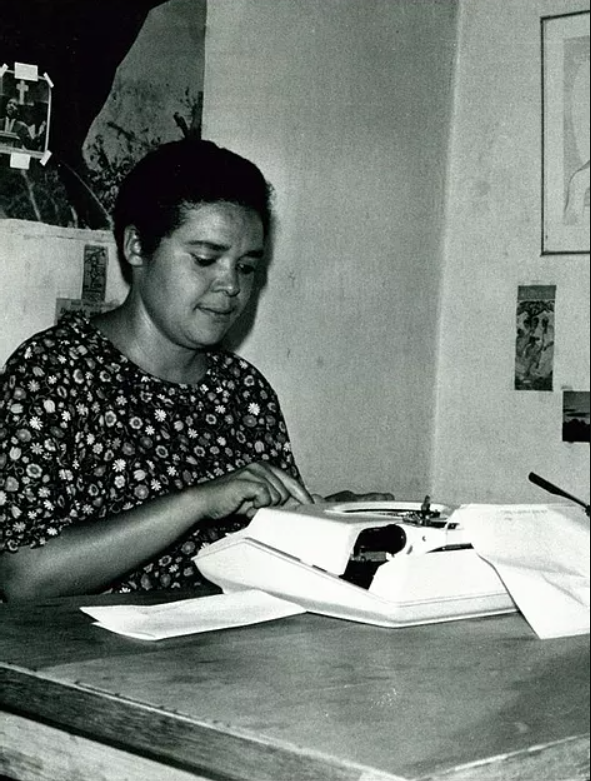
In this edition of Author Spotlight, we will examine the life and works of renowned Ghanaian playwright Efua Sutherland, a woman who didn’t just write plays; she built the very stage that modern Ghanaian drama stands on. If you’ve ever sat in a theater and felt the magic of a story that belongs specifically to your own soil, you have people like Efua to thank. She was a visionary who realized that for a newly independent nation like Ghana, art was the most powerful way to reclaim its soul.
Birth and Early Years
Born Efua Theodora Morgue in 1924 in Cape Coast, Ghana, she grew up in a place where tradition and modernity were constantly dancing together. Cape Coast was a hub of education and history, and Efua was raised with a deep respect for the Fante culture. Even as a young girl, she was a keen observer of the way people moved, spoke, and told stories in the marketplace. These early sights and sounds became the raw material for the legendary “Auntie Efua,” as she was affectionately known.
Education
Efua’s education took her from St. Monica’s Training College in Mampong all the way to England, where she studied at Homerton College, Cambridge, and the School of Oriental and African Studies (SOAS) in London. While many might have stayed abroad, Efua’s heart was firmly rooted in Ghana. She returned home in the early 1950s not just with a degree, but with a burning desire to create a national theater that didn’t just mimic the West, but celebrated the African experience.
Influences
Her biggest influence was the “Ananse” tradition – the clever, mischievous spider-hero of Akan folklore. She believed these oral stories were the “classics” of Africa and deserved to be treated with the same reverence as Shakespeare or Sophocles. She was also deeply influenced by the political energy of Kwame Nkrumah’s era. She shared the vision of a “New Africa,” where cultural identity was the foundation of political freedom. Her work was a response to the need for a national literature that children and adults alike could see themselves in.
Literary Legacy
Efua Sutherland’s literary legacy is perhaps best defined by her masterpiece, “The Marriage of Anansewa.” In this play, she pioneered the “Anansegoro” style, bringing the trickster spider into a contemporary setting to explore themes of greed, family, and wit. She also wrote “Edufa,” a haunting tragedy based on Greek myth but deeply embedded in Ghanaian belief systems.

To really understand her impact, you have to look at how she transformed the theatre from a colonial import into a communal African experience. Her major works, like The Marriage of Anansewa (1975), did something revolutionary: they created a bridge between the oral storytelling of the village square and the professional stage. By formalizing the “Anansegoro” (theatre based on spider tales), she gave Ghanaian drama its own unique DNA. In her play Edufa (1967), she brilliantly reimagined Greek tragedy through the lens of African traditional beliefs about death and sacrifice, while Foriwa (1962) focused on the need for national unity and social change.
Efua was also an author of works for children, including two animated rhythm plays, Vulture! Vulture! and Tahinta (1968), and two pictorial essays, with photographs by Willis Bell (1924–2000): Playtime in Africa (1960), which has been described “a groundbreaking book on Ghana’s play culture”, and The Roadmakers (1961). Many of her short stories can be described as rhythmic prose poems. Voice in the Forest, a book of the folklore and fairytales of Ghana, was published in 1983
Her legacy, however, goes beyond the page. She founded the Ghana Drama Studio, the Ghana Society of Writers, and the influential literary magazine Okyeame. She didn’t just want people to read plays; she wanted them to perform them in the streets, in schools, and in grand theaters. She was also a champion of children’s literature, writing books like Playtime in Africa to ensure that Ghanaian kids grew up seeing their own games and faces in their books.
Efua Sutherland was much more than an author; she was a cultural lighthouse. In the wake of Ghana’s independence, she saw that the colonial education system had left people’s imaginations a bit disconnected from their own roots. She stepped in to fix that, blending the ancient art of village storytelling with the structure of modern theater.
Honours
For her tireless work, “Auntie Efua” became a household name and a respected figure globally. She was a leading light in the Pan-African Historical Theater Festival (PANAFEST), an event that still brings people from across the African diaspora back to Ghana today. She received numerous national awards for her contribution to the arts and education, including Honourary Doctor of Law (1991), awarded by the University of Ghana for her work in dramatic arts and children’s welfare; Noble Patron of the Arts Award (1991), presented by the Ghana Association of Writers; and the Flag Star Award (1995), awarded by the Arts Critics and Reviewers Association of Ghana. Her influence can be seen in the curriculum of every drama school across the continent. She wasn’t just awarded for her writing; she was honored for her role as a “Mother of the Nation’s Culture.”
Beyond the theater, Efua was a mother, an educator, and a fierce advocate for children’s rights. She spent years working with the Ghana National Commission on Children, ensuring that the next generation had the resources to thrive. She lived a life of “cultural activism,” believing that if you give a child a book or a play that reflects their beauty, you give them a future. She passed away in 1996, but her spirit lives on every time a curtain rises in Accra.
That brings us to the end of this week’s Spotlight on Efua Sutherland, the architect of the African stage. Be sure to join us for our next edition, where we will look into the life and works of another literary giant whose words impacted the course of history.