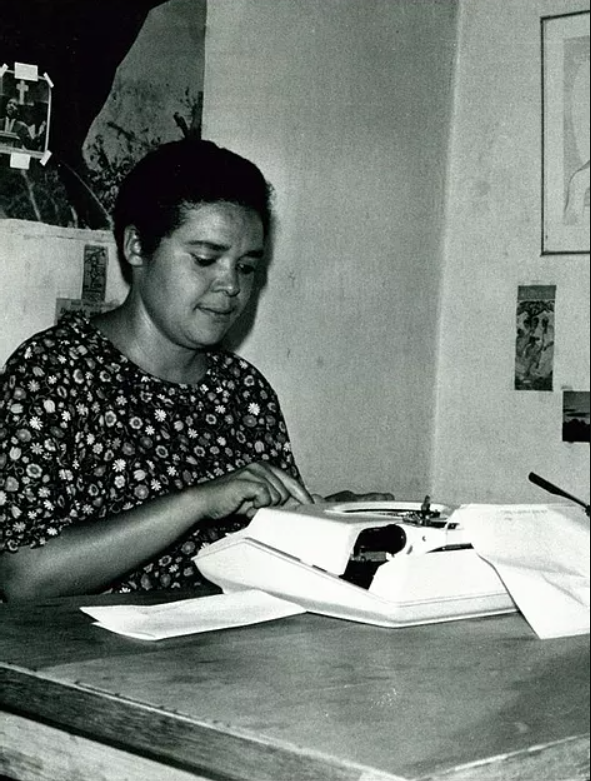
In this edition of Author Spotlight, we will examine the life and works of renowned Nigerian writer Flora Nwapa, a woman who didn’t just walk through the doors of African literature, she built the doorway herself, earning the title of the “Mother of Modern African Literature”. In a literary landscape that was dominated by male voices in the 1960s, she stepped forward and the literary world listened. She didn’t just write about the struggle against colonialism; she wrote about the heartbeat of the home, the marketplace, and the complex inner lives of women who were the backbone of their communities.
Birth and Early Years
Born Florence Nwanzuruahu Nkiru Nwapa on January 13, 1931, in Oguta, Nigeria, Flora’s early years were shaped by the blue waters of Oguta Lake and the legends of Uhamiri, the Lady of the Lake. She grew up in a family that valued education – her mother was a teacher – and she was surrounded by strong, industrious Igbo women. These women weren’t just background characters in her life; they were entrepreneurs, farmers, and leaders, and their influence would later become the soul of every page she wrote.
Education
Flora attended prestigious schools like Archdeacon Crowther’s Memorial Girls’ School in Elelenwo, Queens College, Yaba, Lagos, and later St Anne’s School Ibadan. She earned her degree from the University College Ibadan in 1957, during a vibrant era when Nigerian intellectualism was reaching a fever pitch. Not stopping there, she travelled to Scotland to earn a Diploma in Education from the University of Edinburgh. When she returned to Nigeria, she didn’t just settle into a quiet life; she worked in administration and education, always keeping her eyes open to the stories happening around her.
Influences
Flora was influenced by the oral traditions of her Oguta roots. The stories told by women around the fire and the myths of the water goddess Uhamiri gave her a unique narrative voice. While she was a contemporary of greats like Chinua Achebe, she was fueled by a specific need to correct the record – to show that African women were not just passive victims of tradition or colonial rule, but were agents of their own destiny. Her work was a direct response to the “silence” of women in the early African literary years.
Literary Legacy
Flora Nwapa’s literary legacy is nothing short of revolutionary. In 1966, she published “Efuru,” making her the first African woman to have a novel published in English internationally. It was a groundbreaking moment that shifted the focus of African literature toward the domestic and the feminine. She followed this with “Idu” (1970), which explored the deep bonds of marriage and community.

Perhaps her most enduring contribution, however, was her work as a publisher. Frustrated by how difficult it was for African women to get their voices heard, she founded Tana Press in the ’70s. She became one of the first African women to run her own publishing house, ensuring that the next generation of writers wouldn’t have to wait for permission from the West to tell their stories. Her books like One is Enough (1981) and Never Again (1975) – which dealt with the traumas of the Biafran War – remain essential reading for understanding the female perspective on Nigerian history. Her literary legacy also includes the volume of poetry, Cassava Song and Rice Song (1986), which uses metaphorical narratives to celebrate these crops, focusing on the roles of women and children in agricultural production and, by extension, within patriarchal structures.
Honours
Throughout her life and after, Flora was showered with the respect she earned. She was awarded the Nigerian National Honour (Officer of the Order of the Niger) in 1983 for her contributions to literature. She also received the Distinguished Alumni Award from the University of Ibadan. In 2017, Google honored her with a doodle on her 86th birthday for her contributions to literature. Today, she is remembered not just as a writer, but as a cultural diplomat who put Nigerian women’s lives on the global map.
What many people don’t realize is that Flora was also a dedicated public servant. During and after the Nigerian Civil War, she worked tirelessly in government roles, focusing on the reconstruction of the East Central State and the welfare of children orphaned by the conflict. She lived a life of action, proving that one could be a dreamer, a storyteller, and a leader all at once. She passed away in 1993, but every time an African woman picks up a pen today, they are walking the path that Flora Nwapa cleared for them.
That brings us to the end of this week’s Spotlight on the matriarch of the African novel, Flora Nwapa. Be sure to join us for our next edition, where we will look into the life and works of another literary giant whose words impacted the course of history.